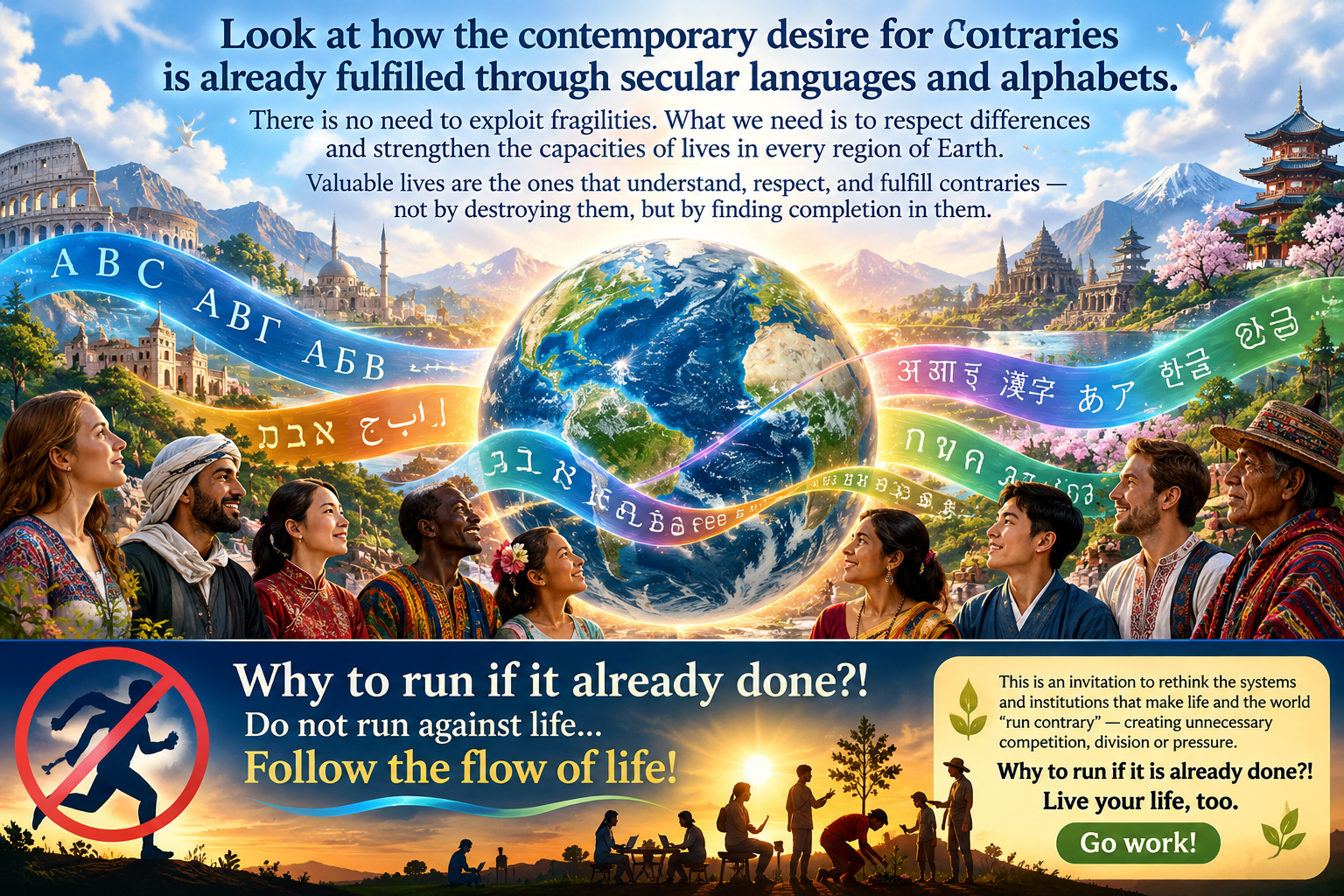
The World run Contrary… But ir has already ran before, better!
Look at how the contemporary desire for contraries is already fulfilled through secular languages and alphabets. There is no need to exploit fragilities. What we need is to respect differences and strengthen the capacities of lives in every region of Earth. Valuable lives are the ones that understand, respect, and fulfil contraries — not by destroying them, but by finding completion in them.
I left a research underneath… It does just prove what I state - Why to run contrary if it is all already made out for thousand of years? What is the urge of contrary if in between the lives on Earth the languages are already “contraries”, already complementary? There is no need to question life, but to understand how fully complete are the aspects on a World that inevitably GO round, and is inevitably as it is. Why to run contrary if for centuries people already WORKED towards a common completion/opposition? Why to question everything that was done by ancients or ourselves in past lives?
Why to run if it already done?!
Do not run against life… Follow the flow of life!
The research: Complementary Contraries
We can now return to the original question and reorganize it in a clearer way.
Latin ↔ Cyrillic
A B C / А Б В
At first sight, they may appear to belong to opposing cultural worlds.
In reality, they are relatives.
Both ultimately belong to traditions shaped by the Greek alphabet, and in some languages they can even represent the same spoken language through different writing conventions.
What looks like opposition on the page can therefore hide a much older relationship underneath.
Latin ↔ Arabic
ABC →← ابت
Here the contrast appears even stronger.
Latin is normally written from left to right.
Arabic is written from right to left.
Visually, they seem to move against one another.
Yet if we travel far enough back into the history of writing, both belong to the much larger story of ancient Mediterranean and Near Eastern writing traditions.
Their present forms are different, but their distant histories are not completely disconnected.
The opposition is therefore not absolute.
It is divergence from a shared human history.
Devanagari ↔ Perso-Arabic
भारत →← اردو
These systems differ in structure, visual logic, historical development, and direction.
Yet Hindi and Urdu provide one of the clearest examples of how different scripts can coexist around closely related forms of spoken language.
Hindi is normally written in Devanagari.
Urdu is normally written in a Perso-Arabic script, especially Nastaliq.
Their literary cultures developed in different directions, but large portions of everyday speech remain mutually understandable.
This means that two writing systems that visually appear almost opposite can encode linguistic worlds that remain deeply connected.
The scripts preserve distinction without necessarily destroying proximity.
Hanzi ↔ Kana
漢字 + ひらがな
In Japanese, this idea becomes even more concrete.
Kanji provides a major lexical and semantic layer.
Hiragana and Katakana provide phonetic information adapted to the Japanese language.
They are not competing for survival.
They literally work together inside the same sentence.
One system carries inherited meaning.
Another carries sound and grammatical structure.
The result is not uniformity, but cooperation.
This may be one of the clearest demonstrations that difference can increase expressive capacity rather than reduce it.
Hanja ↔ Hangul
漢字 / 한글
Korean history presents another form of complementarity.
Chinese characters represented an enormous inherited cultural and intellectual tradition in Korea.
Hangul, however, was created specifically to represent the sounds of Korean more directly and accessibly.
One represents historical inheritance.
The other represents linguistic adaptation.
They therefore demonstrate an important principle: innovation does not always require the destruction of what came before.
A society can inherit one system, create another, and allow both to occupy different historical functions.
Brahmi ↔ Its Descendants
Devanagari, Bengali, Tibetan, Khmer, Thai, and many other scripts may appear radically different today.
Yet they belong, directly or indirectly, to the enormous historical family of scripts associated with the Brahmic tradition.
They are not isolated inventions standing against one another.
They are branches.
Their differences are evidence of centuries of movement, adaptation, religion, trade, political transformation, migration, and local creativity across Asia.
The family resemblance is sometimes obvious and sometimes almost invisible.
But the deeper lesson remains the same:
difference can be the product of connection.
Unicode: A New Stage in This Evolution
The idea of the "union of alphabets" is no longer merely philosophical.
Today it has become technological infrastructure.
Unicode does not require the world to abandon its scripts and write everything in Latin characters.
It attempts the opposite.
It gives different writing systems a shared computational environment in which they can continue to exist as themselves.
So today:
A
Α
А
א
ا
अ
漢
あ
한
can all exist inside the same digital architecture.
In this sense, Unicode can almost be understood as an alphabet of alphabets.
Not because it transforms every writing system into one universal script, but because it creates a common structure capable of recognizing many of them.
This represents an important transformation in the history of writing.
For thousands of years, scripts traveled because people traveled.
Merchants carried them.
Religions transmitted them.
Empires expanded them.
Scholars translated them.
Migrants adapted them.
Printers standardized them.
Now computers reconnect them.
The digital world creates a new meeting place in which systems that developed thousands of kilometers apart can appear together on the same screen.
The aim is increasingly not to eliminate linguistic difference, but to make different systems interoperable.
That is an important distinction.
Unity does not require uniformity.
What "Evolution" Really Means
I would therefore avoid imagining the history of writing in this form:
hieroglyphics → Arabic → Greek → Latin = progress
That would be historically misleading.
Writing did not develop as one civilization replacing an inferior one until humanity finally reached the "correct" alphabet.
A much better model is:
transmission → adaptation → specialization → coexistence → interoperability
Or, more simply:
one people creates
↓
another people learns
↓
adapts it to its own language
↓
creates new letters or new conventions
↓
other peoples receive those innovations
↓
new writing systems emerge
↓
and eventually they meet again
This cycle has repeated itself across thousands of years.
A script rarely remains exactly what it was at the beginning.
Every encounter can transform it.
A letter can change its shape.
A consonant can become a vowel.
A symbol can acquire a new sound.
A foreign alphabet can receive additional letters.
Characters can become simplified.
A writing system can be combined with another.
A new script can be created specifically to solve limitations of an older one.
And now, after centuries or millennia of separation, all of these systems can appear together:
ABCDEFGHIJKLMNOPQRSTUVWXYZ
ΑΒΓΔΕΖΗΘ
АБВГДЕЖЗ
אבגדהוזח
ابتثجحخد
अआइईउऊ
日本語
한글
on the same screen,
inside the same book,
at the same university,
inside the same library,
and across the same global network.
This, to me, is one of the strongest pieces of evidence for the idea behind this discussion.
The evolution of human writing does not point toward the disappearance of differences.
Again and again, it shows peoples receiving something from one another and transforming it without necessarily losing their own identity.
Humanity does not advance only by replacing.
It also advances by absorbing, translating, adapting, preserving, combining, and completing.
What initially appears to be a contradiction may therefore be a relationship viewed from too close a distance.
Latin and Cyrillic can look divided until we follow them back toward Greek.
Arabic and Latin can seem to move in opposite directions until we follow their deeper historical connections.
Hindi and Urdu can appear separated by their scripts while remaining close in speech.
Japanese demonstrates that logographic and phonetic systems can function together every day.
Korean demonstrates that a new writing system can emerge beside an older cultural tradition.
The Brahmic family shows that enormous visual diversity can grow from shared historical roots.
And Unicode shows something new:
after thousands of years of branching outward, humanity has created a technological system capable of bringing those branches back into the same space.
Not by making them identical.
By allowing them to coexist.
That may be the deeper meaning of complementary contraries.
Two things do not always need to become the same in order to belong together.
Sometimes their difference is precisely what allows each one to contribute something the other does not contain.
The history of writing therefore offers a powerful example of a broader human principle:
civilizations do not only evolve by defeating their opposites. They also evolve by learning how to understand them, preserve them, translate between them, and eventually build systems in which differences can coexist without losing their form.
Many alphabets and writing systems that today appear to symbolize separate or even opposing civilizations are, when followed far enough into history, distant relatives, adaptations, or participants in the same networks of cultural exchange.
The farther back we follow the letters, the less rigid the boundary between East and West becomes.
And the farther forward we follow them, the more they meet again.
Different scripts. Different histories. Different directions. One increasingly interconnected human language of exchange.